
Dream home search criteria compared for Brampton buyers
Compare must-haves versus nice-to-haves to build searchable dream home search criteria. Prioritise features, convert them to MLS filters and match to budget.

Dream home search criteria compared for Brampton buyers
Turning a wishful idea of a "dream home" into a repeatable search requires clear criteria and a plan to trade features against budget and market realities. This article compares must-haves versus nice-to-haves, explains a simple scoring method, and shows exactly how to convert each preference into MLS/IDX filters and AI prompts you can use while searching Brampton homes for sale. It also points to practical tools, including address-based valuation and free VIP reports available at the official website to validate your choices.
What this article covers
- How to separate dealbreakers from tradeable perks and score priorities
- Top searchable criteria and exact filter examples for MLS/IDX and AI queries
- Brampton-specific trade-offs for common buyer profiles
- How pre-approval changes must-haves and a printable checklist for showings
Quick checklist for showings
- Must-have pass/fail: beds, baths, commute time, school zone
- Site check: driveway or garage, backyard, foundation signs
- Systems check: roof age, furnace, major appliances
- Price check: list price versus your pre-approved maximum
- Next steps: request a Comparative Market Analysis or book a second inspection
How to split must-haves and nice-to-haves
Start by thinking of must-haves as non-negotiable requirements that would stop you from buying a property. Nice-to-haves are features you would prefer but will trade if needed to stay within budget or location. Zillow recommends separating needs and wants so your search stays focused and realistic when you bring your list to an agent or a search tool.
Scoring your priorities (1 to 5)
Assign each item a score from 1 to 5 where 5 means "cannot live without" and 1 means "purely aspirational." Use the sum to sort features into must-haves (scores of 4 or 5) and nice-to-haves (scores 1 to 3). A small scoring worksheet helps you make consistent trade-offs when multiple properties qualify.
A simple trade-off exercise for budget limits
When budget or market competition forces a decision, simulate two scenarios: keep your top three must-haves and drop the most expensive nice-to-have, or keep two must-haves plus one aspirational item that improves resale. This exercise makes real the choices you will face during bidding and prevents emotional overreach.
Top searchable criteria and how to turn each into MLS/IDX filters
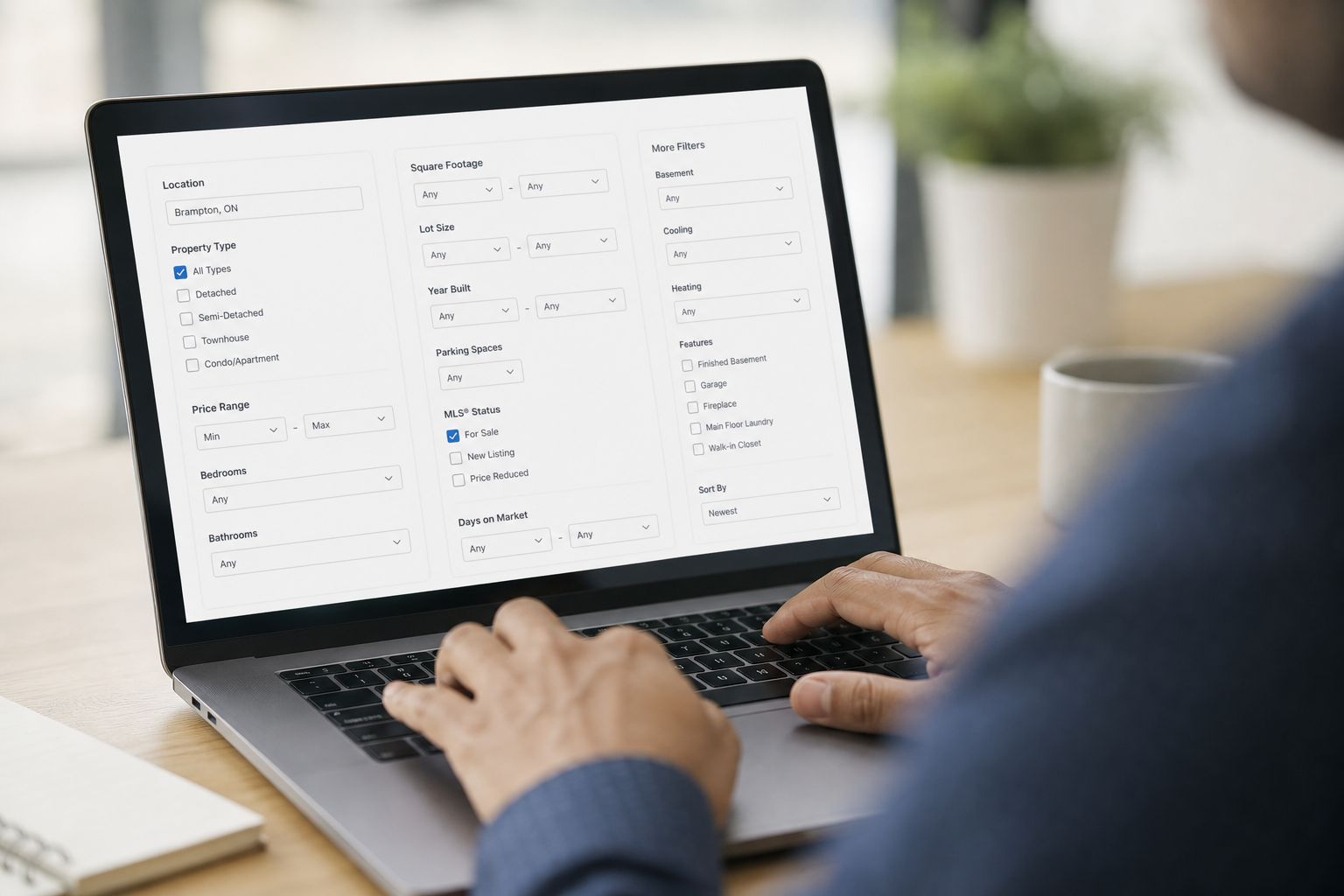
Below are the common criteria buyers use along with the concrete filter names and sample values that work on most MLS/IDX systems. Redfin and Forbes stress matching home type to lifestyle and budget as part of a successful house hunt.
Property fundamentals
- Beds and baths — MLS filters: Minimum beds = 3, Minimum baths = 2. AI prompt example: "Find 3 plus bed, 2 plus bath detached homes in Brampton under $X."
- Property type — Filter: Detached, Semi-detached, Townhouse, Condo. Decide whether you want freehold ownership or condo maintenance trade-offs.
- Square footage — Filter: Min finished area 1,200 sq ft. Use an approximate range rather than an exact number to widen options.
Site and outdoors
- Lot size and backyard — Filter: Lot size or lot frontage where available, or use property type as proxy. AI prompt: "yards suitable for small children or a vegetable garden."
- Parking — Filter: Garage, Driveway, Tandem. If parking is critical, mark it as a must-have and set the filter to "Garage" only.
Location and commute
- Neighbourhood — Filter: City, Postal code, or neighbourhood name. Use drive-time or transit proximity where the MLS supports it.
- Commute time — Use mapping tools or an AI prompt like "homes within a 30 minute drive to [work address] during morning peak." One Place recommends concrete, searchable attributes for AI queries rather than vague descriptions.
Schools and amenities
- School zone — Filter by school name or district if available. Check school rankings separately before committing.
- Local amenities — Filter by walking distance to transit or shops where supported, or add this to your AI prompt: "nearby parks and grocery stores."
Condition, age and systems
- Year built — Filter: Built after 1990 if you want newer systems.
- Renovation level — Use keywords in saved searches, for example "updated kitchen" or "recently renovated." Always verify with pictures and disclosure documents.
Budget and taxes
- List price — Set a strict maximum equal to your pre-approved figure. Consider adding a five to ten percent buffer for bidding in competitive situations.
- Property taxes and condo fees — Add these into your monthly cost calculations rather than ignoring them on sticker price.
Brampton-specific trade-offs: housing types, commute and neighbourhoods
Brampton buyers typically choose among detached homes, townhouses and condos. Each type brings different lot sizes, maintenance expectations and price points. Forbes Advisor Canada recommends prioritising neighbourhood and long-term affordability when making trade-offs.
Common Brampton housing types
- Detached — More private outdoor space and larger lots. Often preferred by growing families. Expect higher listing prices and maintenance responsibility.
- Townhouse — Middle ground on price with some outdoor space and less exterior maintenance.
- Condo — Lower entry price and less maintenance. Best for commuters and first-time buyers who accept condo fees.
Profile-based trade-offs
- First-time buyer — Must-haves: affordability, safe neighbourhood, transit or commute under 40 minutes. Nice-to-haves: garage, large lot. Consider condos or small townhouses first.
- Growing family — Must-haves: three plus bedrooms, good school zone, backyard. Nice-to-haves: finished basement, larger lot. Townhouses can be a budget-friendly alternative to detached homes.
- Urban commuter — Must-haves: short drive to highways or commuter transit, low maintenance. Nice-to-haves: large yard, quiet street. Condos near major transit nodes can reduce commute time.
Align the wish list with budget and financing readiness
Getting pre-approved reshapes your must-haves by clarifying what you can competitively afford. Opendoor notes that once buyers are pre-approved, active searches tend to become more focused and efficient. Use a pre-approval to set a firm maximum list price and to estimate monthly carrying costs including mortgage, taxes and utilities.
How pre-approval changes your search
- It replaces guesswork with a concrete price ceiling for MLS saved searches.
- It helps you decide whether to trade a garage or extra bedroom to stay inside your budget.
Example rebalancing
If your pre-approval is lower than expected, re-score your wish list. Swap an expensive nice-to-have such as a finished basement for a must-have like proximity to a desired school. These kinds of rebalances keep the search practical and aligned with long-term affordability.
Turn the wish list into AI queries, MLS alerts and saved searches

One Place recommends describing your dream home to AI using concrete attributes. Below are sample saved searches and AI prompts that work for Brampton listings.
Sample MLS saved search
- Location: Brampton or postal codes L6P, L6R
- Property type: Detached or Townhouse
- Beds: 3 plus
- Baths: 2 plus
- Max list price: $X (your pre-approval limit)
- Alerts: New listings only, within last 24 hours
AI prompt examples for property search
- "Show 3 plus bedroom detached homes in Brampton under $X with a two car garage and backyard suitable for children."
- "Find townhouses near GO transit with 2 plus bedrooms and a private driveway within a 35 minute commute to [work address]."
- "List newly renovated condos in central Brampton with low maintenance fees and assigned parking."
Setting effective new-listing alerts
Use narrow, concrete filters and opt into immediate notifications for new listings. If inventory is low, broaden a single criterion at a time to expand daily results without losing focus.
When to lean on an agent and negotiation tactics in a competitive Brampton market
An experienced buyer agent helps translate your scored wish list into a formal search, arrange timely showings and produce competitive offers. TheReliableRealtor.ca highlights buyer representation and negotiation expertise as useful services to expect from a REALTOR. Redfin also recommends local agent expertise for scheduling, interpreting market cues and crafting offers.
When to request a formal CMA
Ask for a Comparative Market Analysis when you find a serious contender. A CMA helps confirm list price fairness and sets a realistic offer strategy.
Offer strategies to consider
- Include a solid deposit to show commitment.
- Use escalation clauses sparingly and only with an agent who can validate comparable sales.
- Consider limiting conditions when you are competitively positioned and your inspector or financing timelines are secure.
What an agent with negotiation expertise will do for you
An agent with buyer advocacy and negotiation credentials will advise on offer structure, timing and contingencies. Robin Patel lists ABR and RENE among his professional designations on the official website, which signals an emphasis on buyer representation and negotiation support.
Printable checklist, common objections and decision criteria to use at showings
Use the checklist below at showings and when comparing multiple offers.
Printable decision checklist
- Must-have pass/fail: [ ] Beds [ ] Baths [ ] Commute [ ] School
- Budget check: List price $_____ vs my max $_____
- Major systems: Roof age ____ Furnace ____
- Exterior: Drainage OK [ ] Backyard usable [ ] Garage or parking [ ]
- Notes to agent: Request CMA [ ] Request seller disclosure [ ] Book second visit [ ]
Common buyer objections and short responses
- "I want neighbourhood X but cannot afford it" — Consider nearby streets, smaller property type, or longer commute to reduce cost.
- "The house needs work" — Ask for a renovation estimate and factor that into your maximum offer.
- "I am worried about bidding wars" — Have pre-approval and decision rules ready to avoid rushed choices.
Final decision criteria: a property should pass all must-haves, have only acceptable trade-offs among nice-to-haves, and fit within your pre-approved budget. Walk away if the price would stretch your long-term affordability.
Frequently asked questions
How many must-haves should I list before I start searching?
Keep must-haves to three to five non-negotiable items. Too many must-haves will shrink options. Use your top three plus two conditional items to allow flexible trade-offs during the search.
How do I convert my wish list into MLS filters and alerts for Brampton homes for sale?
Map each wish-list item to an MLS field such as Beds, Baths, Property Type, List Price, Lot Size or School District. Create a saved search with those fields and set alerts for new listings. Use narrow filters at first and broaden one item at a time if results are sparse.
Will getting pre-approved change my dream home priorities?
Yes. Pre-approval gives a firm price ceiling which often forces re-scoring of nice-to-haves into lower priority or into planned future renovations. Pre-approval makes searches realistic and faster.
What should I ask an agent when I want help turning my wish list into offers?
Ask the agent for a CMA, local market cadence for similar homes, recommended offer structure, and negotiation strategies used in low-inventory situations. Confirm how quickly they can arrange showings and communicate new listings.
If a house meets most but not all must-haves, how do I decide whether to bid?
Apply your pre-agreed scoring. If the property fails a top-three must-have, it is usually best to pass. If it fails a lower-ranked item and other metrics are strong, request a second viewing and a CMA before deciding.
Key research and planning resources cited in this article include advice on wish lists from Zillow, a house-hunting checklist from Redfin, timing and pre-approval guidance from Opendoor, neighbourhood and feature prioritisation from Forbes Advisor Canada, and AI search best practice from One Place. Use those resources alongside local tools like the official website for address-based valuations and free VIP reports to validate your shortlist.
Ready to turn your checklist into active searches or to request a free VIP real estate report and a Comparative Market Analysis? Contact Robin Patel for buyer representation and local market guidance.